
Discover the power of ancient stories
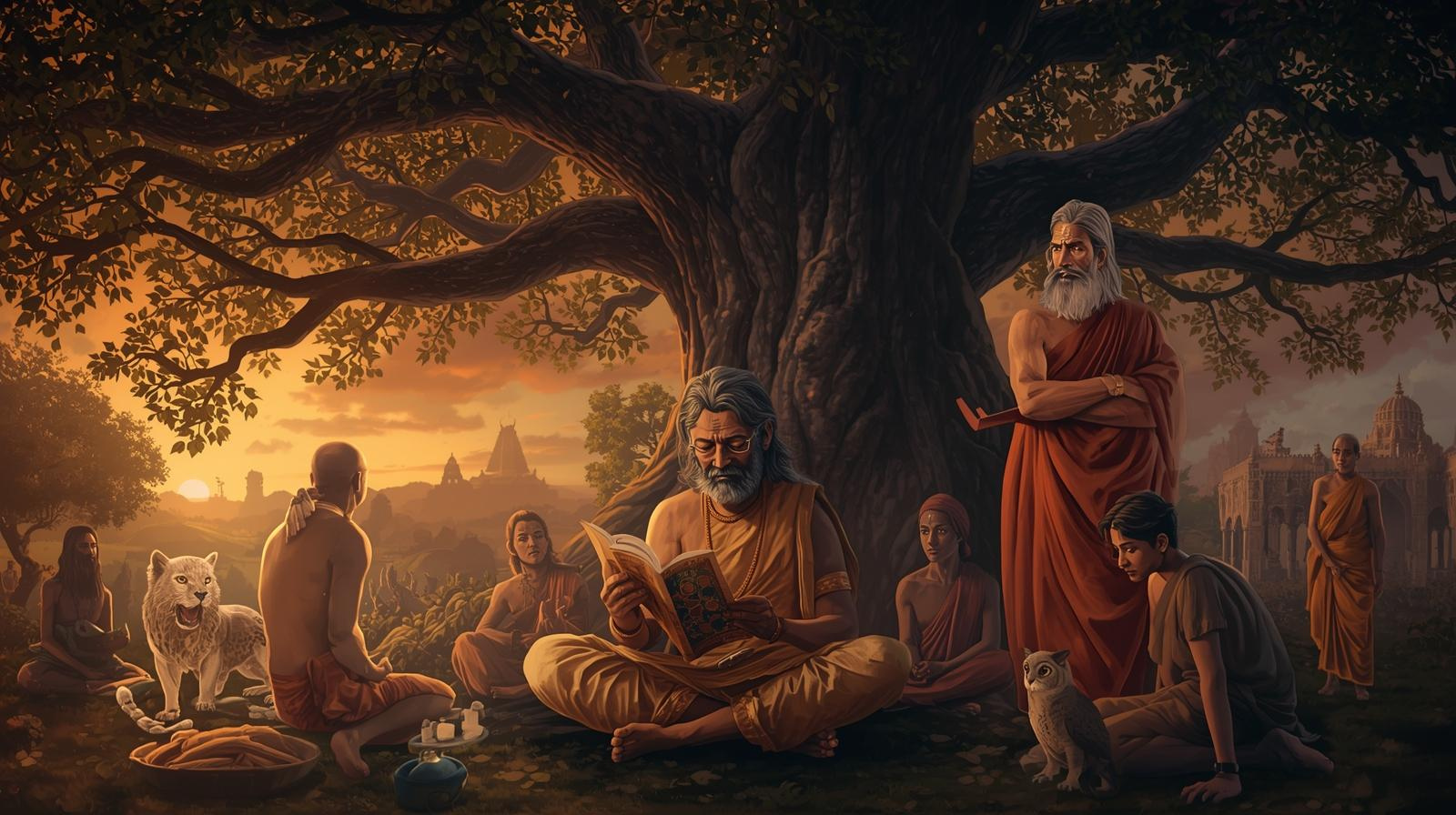
Timeless leadership lessons
Why I Use Ancient Stories
I use ancient stories not because they are old, but because they are unfinished.
Modern writing often tries to explain too much. It rushes to conclusions, offers advice quickly, and closes questions neatly. Ancient stories do the opposite. They leave space. They do not instruct directly; they reveal slowly. That quality makes them uniquely suited for thinking about leadership, ethics, work, failure, and human behaviour.
Ancient stories were not written to impress an audience.
They were shaped to outlast one.

Ancient Stories Study Humans, Not Events
News explains what happened.
Ancient stories explore why humans behave the way they do.
Fear, ambition, loyalty, greed, compassion, self-deception—these patterns have not changed. Technologies evolve, organisations scale, and social structures shift, but the inner life of human beings remains remarkably consistent.
This is why stories from the Upanishads, the Jataka Tales, or the Hitopadesha still feel relevant. They are not anchored to a time-bound context. They are anchored to human nature.
They Do Not Moralise — They Observe
One reason I trust ancient stories is that they rarely preach.
They show:
what happens when restraint is ignored,
how small compromises accumulate,
how power distorts perception,
how intelligence fails when ego intervenes.
But they rarely tell the reader what to think.
A Jātaka story does not say, “Be ethical.”
It shows what unfolds when ethics are absent.
A Hitopadeśa tale does not say, “Choose your allies carefully.”
It lets consequences speak.
This non-intrusive quality respects the reader’s intelligence.
Ancient Stories Slow the Reader Down
Modern content is designed for speed—fast consumption, fast reaction, fast forgetting.
Ancient stories demand something else: attention.
They unfold gradually. Their meanings are not always obvious. Often, the same story reveals different insights at different stages of life. What once sounded like a simple tale later becomes a mirror.
This slowness is not inefficiency.
It is depth.
In a world overwhelmed by information, stories that slow thinking down are not outdated—they are necessary.
They Hold Complexity Without Simplifying It
Modern discourse often forces binary positions: right or wrong, success or failure, strength or weakness.
Ancient stories are comfortable with ambiguity.
Characters are rarely perfect. Choices are rarely clean. Dharma is shown as situational, not absolute. This is especially visible in Indian narrative traditions, where moral clarity is achieved not by rigid rules, but by discernment in context.
This makes ancient stories ideal for discussing:
leadership dilemmas,
ethical gray zones,
conflicting responsibilities,
decisions under pressure.
They do not offer templates. They offer perspective.
Stories Travel Where Arguments Cannot
An argument convinces the mind.
A story enters quietly.
Stories bypass defensiveness. They do not confront; they invite. A reader may resist advice, but will sit with a story. Long after the details are forgotten, the pattern remains.
This is why traditions across cultures—from Aesop to Zen, from Indian fables to Sufi humor—chose stories as their primary teaching medium.
Even the absurdity of Mulla Nasruddin Stories works because it exposes human foolishness without humiliation. Laughter opens insight where seriousness often fails.
Ancient Stories Create Continuity
Using ancient stories is also an act of continuity.
They remind us that we are not the first generation to struggle with:
power and restraint,
ambition and fatigue,
success and emptiness,
certainty and doubt.
Others have walked this terrain before. They observed carefully. They left behind not theories, but narratives that carry memory.
To engage with these stories is not to retreat into the past.
It is to borrow a longer lens.
Why I Choose Stories Over Advice
Advice expires quickly.
Stories endure.
Advice assumes certainty.
Stories respect inquiry.
Advice often flatters the writer.
Stories humble both writer and reader.
I use ancient stories because they allow me to explore ideas without closing them. They help me write essays that reflect rather than instruct, question rather than conclude.
If a reader finishes an essay with clarity, that is good.
If a reader finishes with a deeper question, that is better.
I use ancient stories because they are not relics.
They are containers of human insight.
They do not compete with modern knowledge; they correct its excesses.
They do not replace analysis; they deepen it.
In an age that speaks constantly, ancient stories listen.
In a culture that rushes to answers, they stay with the question.
That is why I return to them.